Quick answer
Agentic Franchising is a management model in which the franchisor stops replicating a frozen standard and starts learning from every unit in the network with AI agents. The term comes from the book of the same name by Daniel Guedes, CEO of L'Entrecôte de Paris, who built the agents described in it on Tess and dedicates a full chapter to how. His diagnosis is simple: franchising's bottleneck was never the standard, it was the human inability to learn from hundreds of units at once. Agents remove that bottleneck; the standard stays, and it finally starts to evolve.
What is Agentic Franchising?
Agentic Franchising is a franchise network management framework based on AI agents specialized by department, coordinated by orchestrators that learn from the results of the entire network.
The thesis starts from a simple distinction. Traditional franchising operates under replicative logic: someone discovers a model that works, freezes that model into manuals, and trains franchisees to reproduce it with maximum fidelity. Learning happens once, at the discovery, and then it stops.
Agentic Franchising proposes a generative logic: the base model exists, but it is treated as a living starting point. Every unit in operation generates data. What works in one market is tested in others. Knowledge rises from the front line to the center and returns to the front line in actionable form.
Guedes is explicit about what he is not proposing: this is not a break with the standard, nor the replacement of people by software. It is the removal of a cognitive bottleneck. With 10 franchisees, a consultant can learn from each one by phone and site visit. With 200, there is no human time for that — and rigid standardization was historically the way to scale without having to learn.
Why did replicative logic stop being enough?
Because the standard's life cycle got shorter. A food network today tests products almost every week, adapts its menu by region, responds to online reviews in real time, and adjusts prices according to local competition. A manual printed two years ago is already outdated the day it arrives.
There is an additional cost, and it is behavioral. When the franchisor treats the franchisee as an executor, the franchisee starts behaving like one: does the minimum, follows the protocol, transfers responsibility. The franchisee who questions, adapts, and tests, precisely the one who carries valuable tacit knowledge, is frequently treated as a deviation to be corrected.
What is the difference between an agent and a tool?
An AI agent acts; a tool waits for a command. That is the distinction that holds up the entire framework.
The analogy Guedes uses: a GPS is a tool — it shows the way, but you do the driving. A self-driving car is an agent — it receives the destination and decides route, speed, and stops. In the first case you do the work; in the second, you delegate.
The book describes four capabilities of a well-built agent:
| Capability | What it does | Example in the franchisor |
|---|---|---|
| Perception | Continuously monitors data and detects events | Spots a sales drop at the unit today, not at month-end closing |
| Decision | Chooses the course of action within defined limits | Classifies the severity of the deviation and defines the intervention |
| Action | Executes in the real world, through integrations | Schedules a visit, transfers inventory, triggers a communication |
| Learning | Observes the outcome and adjusts behavior | Starts using more of the approach that converted better |
The author also brings in a technical concept that matters for anyone taking this to production: faithfulness. An agent is faithful when its answers and decisions are consistent with the sources it accesses and with the goals it was given. Faithfulness is not a magical attribute of the model: it is the result of architecture, with validation layers, explicit verification, and feedback loops. For a network where the agent will suggest prices, negotiate with a lead, or collect from a franchisee, this is a prerequisite, not a detail.
Why did Guedes choose Tess as the book's platform?
Chapter 9 of the book, titled "TESS: From Architecture to a Real Agent", answers the question that separates those who read from those who implement: what, exactly, do you build this with?
Guedes points to three characteristics that make Tess suited to operationalizing the framework:
Agent Studio. The environment where an agent is created from three definitions — instructions (what it does and how), knowledge (documents, spreadsheets, manuals that serve as its base), and tools (what it can access and execute). No programming required, which means the expansion consultant can build the lead qualification agent themselves.
Orchestration across models. Different models have different strengths: one reasons better, another is faster and cheaper for simple tasks, another handles colloquial Portuguese better in a negotiation. Instead of picking one and living with its limitations, each task goes to the right model — and models can review each other's work before the final delivery.
Integrations. An agent trapped in a chat window does not solve a franchisor's problem. It needs to read the CRM, write to the ERP, send WhatsApp messages, generate documents, update spreadsheets. On Tess this happens through the API and through automation tools such as Zapier and Make.
The book walks through the complete path of building a lead attraction agent in eight steps, from the briefing in Agent Studio to sharing the published agent with the entire expansion team — so consultants work from the same validated base instead of each one reinventing their own approach. The author's estimated timeline to go from idea to a tested agent: one week of focused work, not a quarter-long IT project.
The author is a Tess customer, and that matters
Daniel Guedes is CEO of L'Entrecôte de Paris, a network already running AI agents built on Tess inside its operation. In other words, the book is the formalization of a method the author applies in his own company.
That is the detail that changes how the book reads. Most content about AI in franchising is written by people observing the sector; here, the framework comes from inside a real operation, with real franchisees, real collections, and real delinquency.
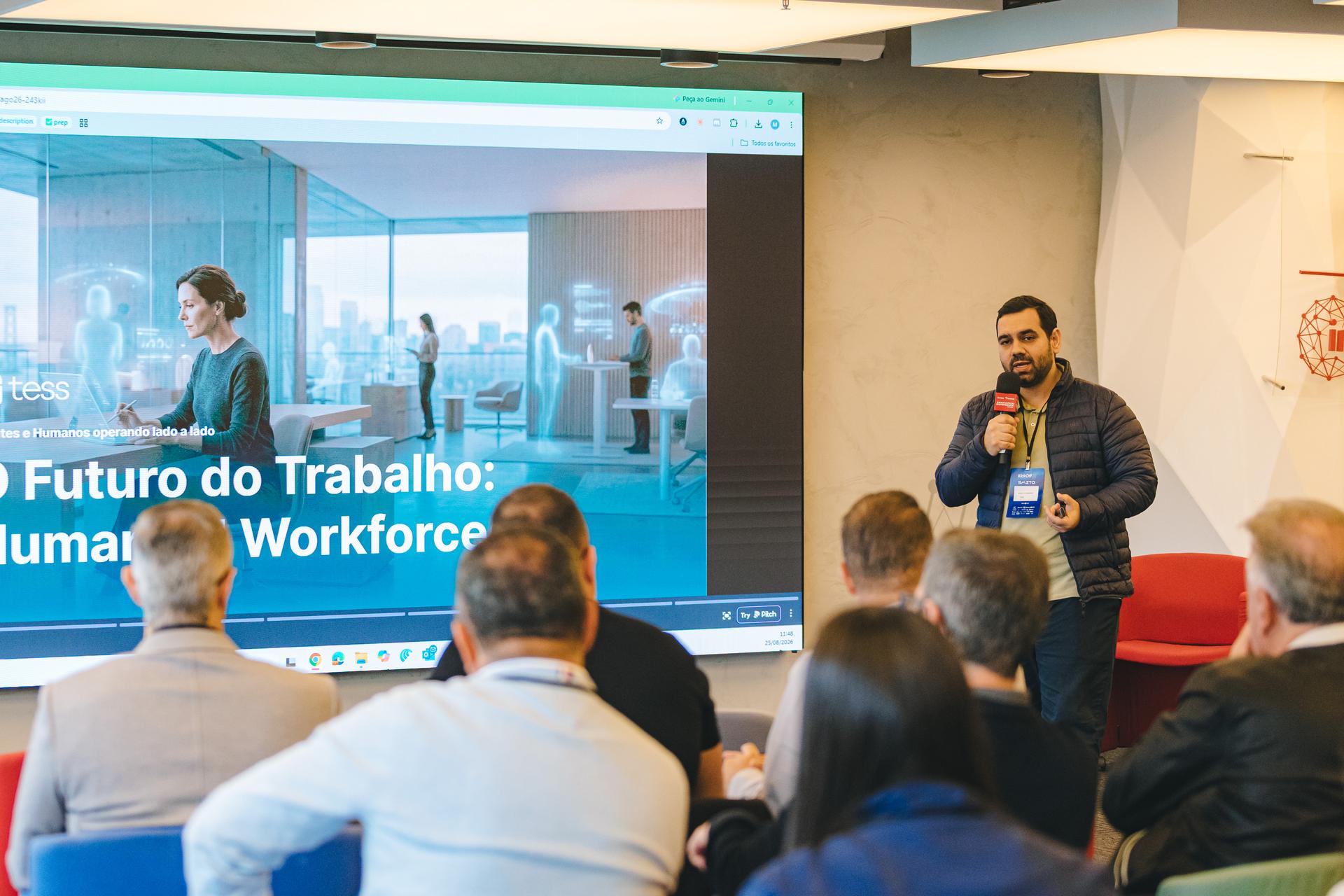
To present the thesis, Daniel took the stage at SMZTO KickOff 2027. During the event, Renato Ferreira, CRO and cofounder of Tess, joined the conversation about how franchise networks are putting agents into operation — not in a lab pilot, but in the daily routine of expansion, support, and finance.
Why build franchising agents on Tess?
The answer lies in scale: a network does not need one agent, it needs an entire operation of agents, agentic teams managed by humans, with governance.
This is where the difference between having a good tool and having an entire operation shows up. On Tess, the franchisor finds more than 330 AI models for text, image, audio, and video, plus supporting features, in a single environment with shared context — which avoids the common scenario of each department buying its own subscription and none of them talking to each other.
For network leaders, three points usually weigh more than building the agent itself:
Governance and control: defining what each person, agent, and team can access, with budgets set per user, per agent, and per team. In franchising, where discount policy and franchisee data are sensitive, this is a requirement.
Hybrid work between humans and agents: With Cowork, leadership sees what teams are executing and what each person's agents are executing, in the same place.
Scaling department by department: The same environment serves the collections agent in finance, the qualification agent in expansion, and the monitoring agent in support, without multiplying vendors.
If you want to understand the logic before you build, talk to our team.
Is it worth it? When to start (and when to wait)
Start now if your network has minimally structured operational data, a repetitive process with clear rules (royalties, lead qualification, KPI monitoring), and someone internal willing to own the pilot. The return shows up quickly because the scope is small and measurable.
Wait, and get your house in order first, if network data arrives as a spreadsheet sent at month-end, critical processes are not documented, or there is no definition of who approves what. In that scenario, the agent will amplify the inconsistency that already exists.
The honest test is this: if you cannot explain in one page how the process works today, there is no way to instruct an agent to execute it.
Frequently asked questions
What is Agentic Franchising?
Agentic Franchising is the concept presented in Daniel Guedes' book to describe a franchisor that learns continuously from its network using AI agents specialized by department, as opposed to the replicative model based on frozen manuals.
Where does Tess appear in the book Agentic Franchising?
In Chapter 9, "TESS: Da Arquitetura ao Agente Real," where the author presents Tess as the platform he chose to build the agents described in the book, detailing Agent Studio, orchestration across models, and integrations with CRM, ERP, and WhatsApp.
How long does it take to put the first franchise agent into operation?
The book estimates one week of focused work to go from idea to an agent tested with a small group of real users, within a broader roadmap of 3 to 6 months of foundation work and 3 to 4 months of piloting.
Do AI agents replace field consultants in a franchise network?
No. The framework proposes the opposite: agents take over monitoring, triage, and repetitive execution, and the consultant moves to complex cases and decisions that require judgment. The book is direct in stating that an agent without human supervision is a risk, not an achievement.
Where should a franchisor that has never used AI begin?
With the simplest process, not the most critical one. Royalty collection, lead qualification, and unit KPI monitoring are the three recommended candidates, because they have clear rules and structured data.
Build the first agent for your network
The architecture is still yours. Tess is where it leaves the page.